
Our Products
Five live, two open source, one still in development. Separate sites, separate audiences, built to the same rules.
echoRune
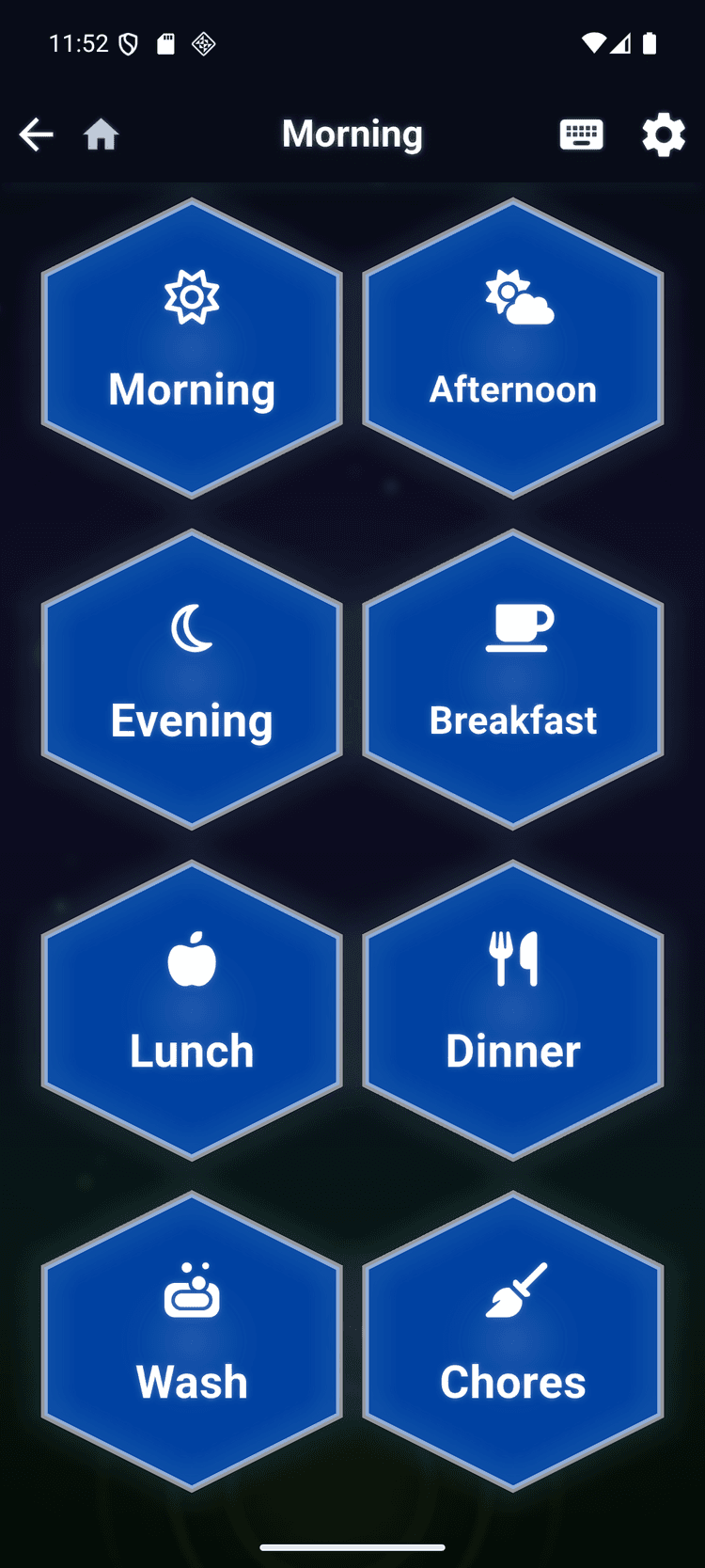
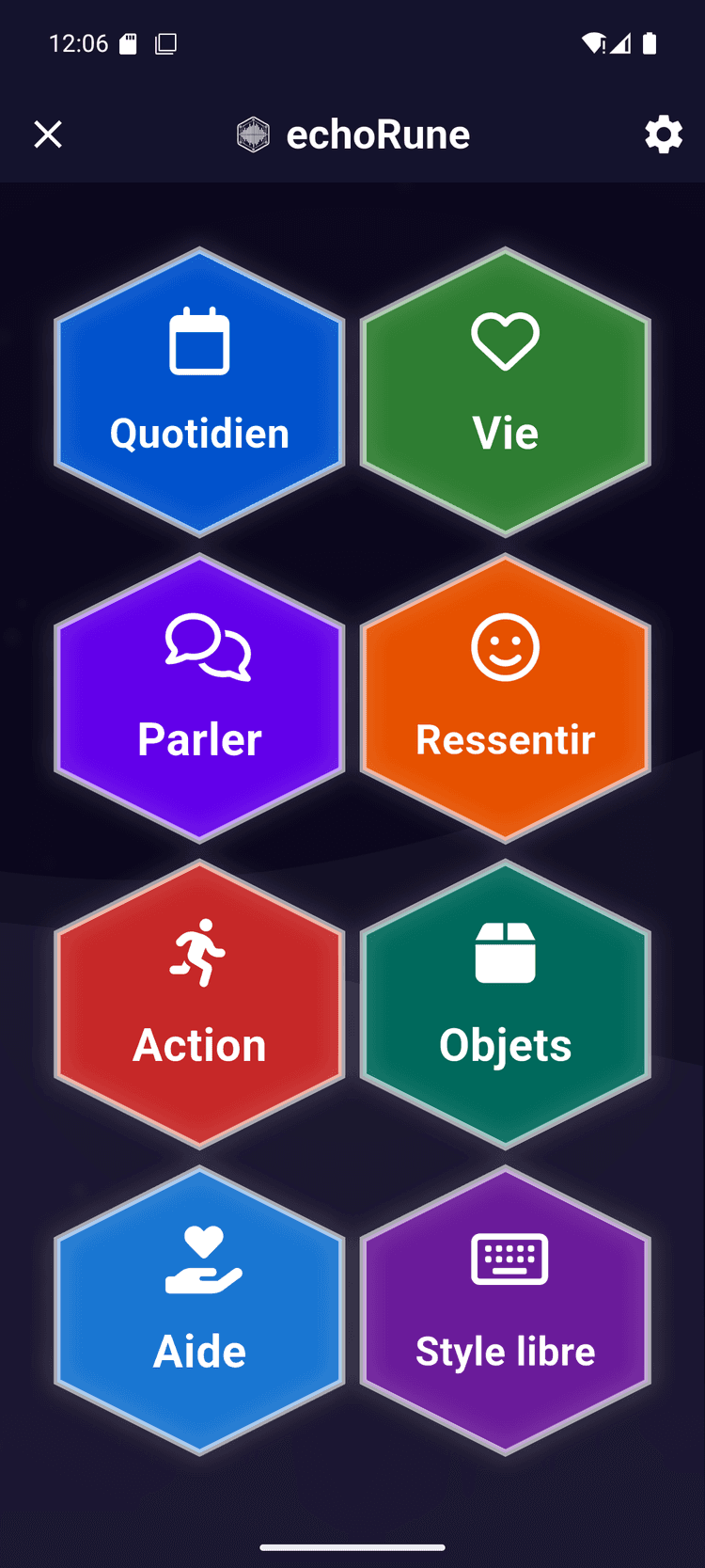
A free communication app that turns a tapped word into speech, in 28 languages. No delay, no setup screen, and no account to create before it does anything.
512 words sit in a hexagonal grid across eight categories, chosen against AAC vocabulary. It runs on Android, iOS, web, Windows, macOS, and Linux. It costs nothing and it collects nothing.
Tap, and it speaks
No send button, no loading state, no round trip to a server. The word is spoken the moment it's pressed.
28 languages
English through to Arabic and Urdu. Voices are gender-selectable, and right-to-left languages get a right-to-left layout.
Nothing is collected
No accounts, no analytics, no profile. COPPA and GDPR compliant, because there is no data on the other end.
Built to WCAG 2.1 AA
AAC-aligned vocabulary across eight categories, at sizes and contrast ratios that hold up on a phone held at arm's length.
512 words, one grid
The hexagonal layout stays put. A word sits where it sat yesterday, and for a daily user that's the whole point.
Six platforms
Android, iOS, web, Windows, macOS, and Linux. There's no setup step before the first word.
bytario
Convert images, manipulate PDFs, generate QR codes, transform data. 35 tools, no uploads, no tracking, no account.
The free browser version runs on WebAssembly, so files are processed on your own machine and never sent anywhere. For automation, the API serves the same tools from Cloudflare's edge network.
Image processing
Convert, resize, compress, crop, rotate, and strip metadata. Generate favicon sets from any source.
PDF toolkit
Merge, split, rotate, watermark, compress, protect, extract text, and fill forms, without a different site for each job.
QR and barcode
Generate and read QR codes plus full barcode support for EAN, UPC, Code 128, DataMatrix, and more.
Data transforms
Base64, URL encoding, JSON formatting, CSV conversion, markdown rendering, diffs, and color conversions.
Runs in your browser
WebAssembly core processes files locally. No uploads, no server round-trips on the free tier.
Privacy by default
Files never leave your device on the free site. API keys are hashed at rest. No accounts required.
sneyk
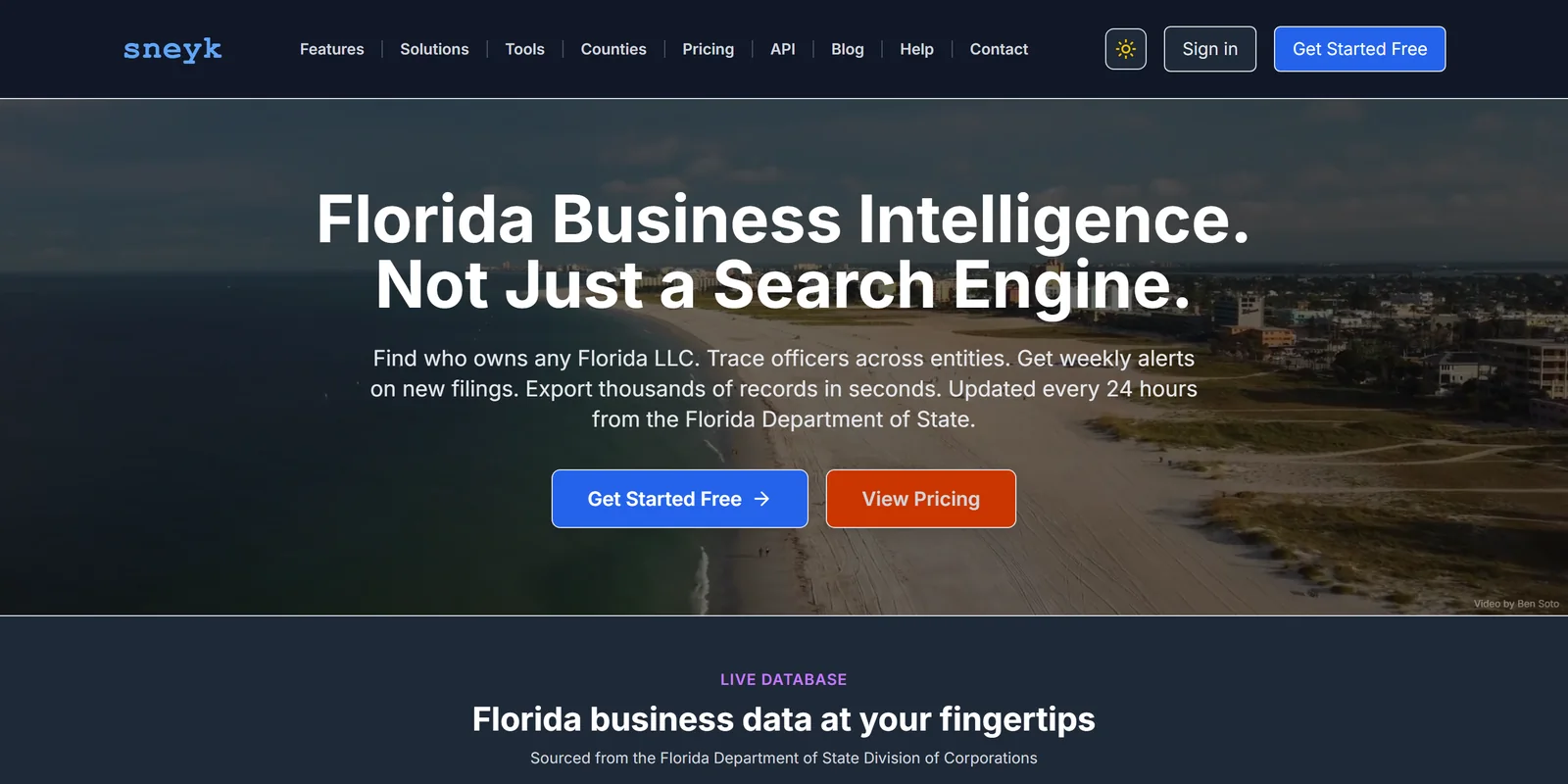
Florida business intelligence, not just a search box. Find who owns an LLC, trace an officer across every entity they are attached to, and watch new filings in the counties you care about.
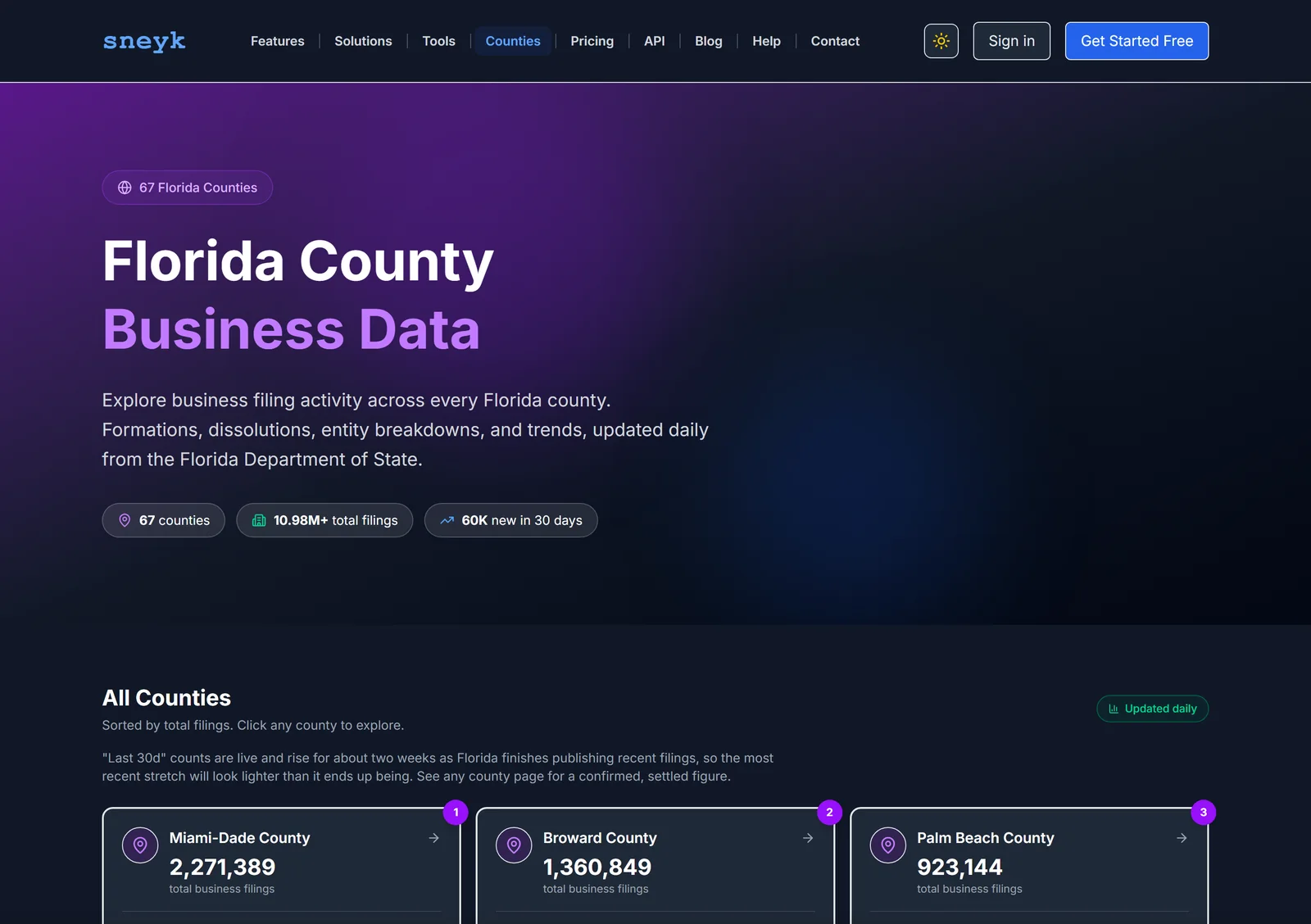
sneyk holds more than 22 million records across 11 data categories from the Florida Department of State, refreshed every 24 hours. Search it in the browser, export it in bulk, or pull it through the REST API. Free accounts get 25 searches a month.
- Records
- 22M+
- Categories
- 11
- Counties
- 67
Officer network analysis
Search a person and see every Florida business they touch as officer, director, or registered agent. Filter by county, time range, and active status.
Combined records
One cross-entity view that pulls a filing together with its related events, debtors, and secured parties instead of leaving you to stitch them yourself.
Geographic analytics
Choropleth maps and heatmaps across all 67 Florida counties. Compare filing density and regional trends by entity type and time period.
Updated every 24 hours
New registrations and filing events are pulled daily from the Florida Department of State Division of Corporations.
Bulk export
Export up to 10,000 records per file as CSV, Excel, or JSON, or pull the pre-generated daily export files for each data category.
REST API
Documented REST endpoints at 2,000 requests per hour, so Florida entity data can feed a CRM, a compliance workflow, or your own product.
Pactbound
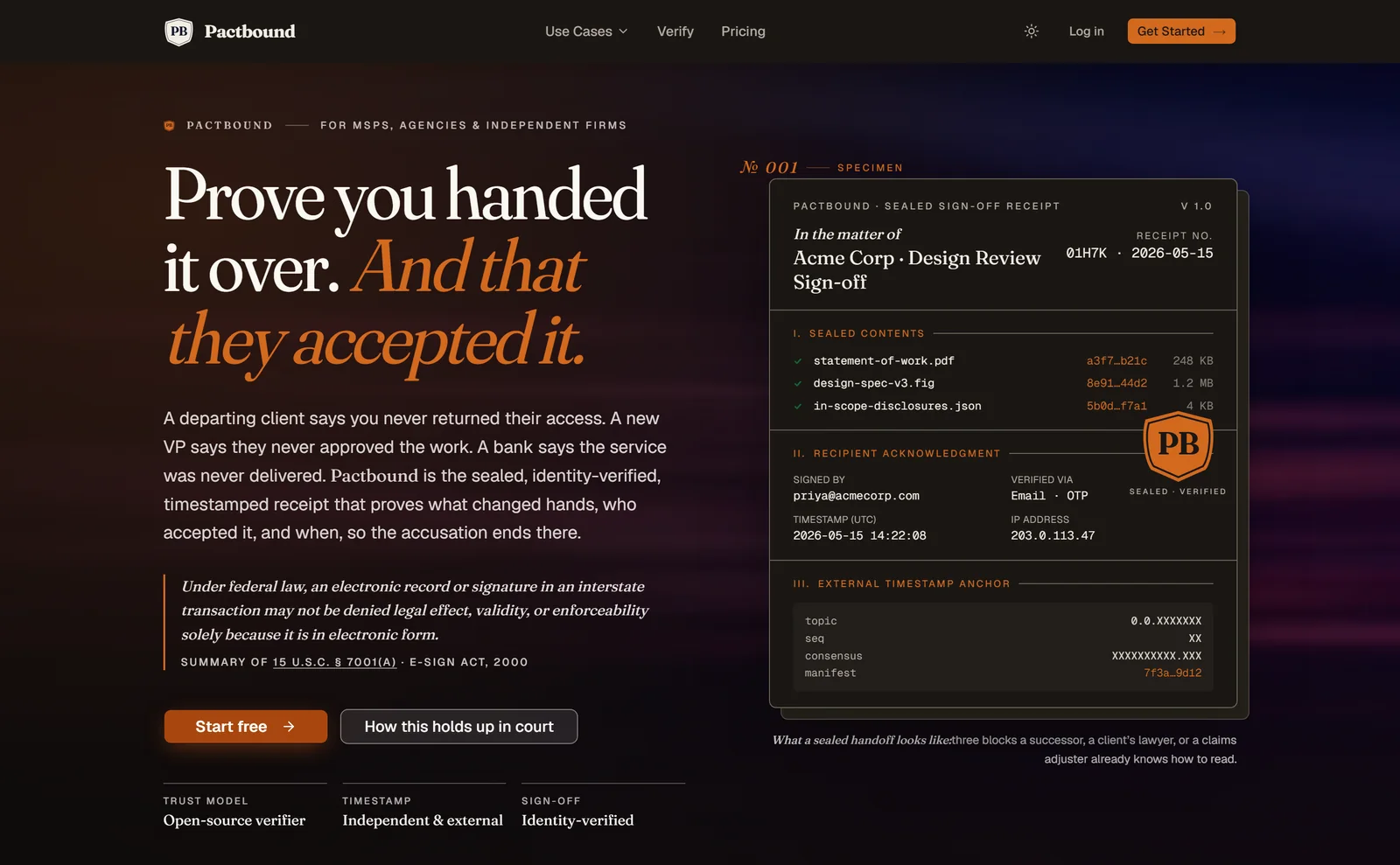
Proof that you handed it over, and that they accepted it. Pactbound turns a credential handoff, an offboarding, or a scope sign-off into a sealed receipt that a third party can verify on their own.
Six months after a clean offboarding, a former client says you left them exposed and never told them. The record is scattered across three inboxes and nobody will corroborate it. Pactbound is what that handoff should have gone through: files hashed, acceptance identity-verified, and the whole bundle timestamped against an external ledger so the date does not rest on our word.
Built for MSPs, agencies, bookkeepers, contractors, property managers, and fractional CFOs, with a free tier to try on a single handoff.
Sealed contents
Every file in a handoff is hashed with SHA-256 and bound together under a single Merkle root, so a changed byte is a changed bundle.
Identity-verified sign-off
The recipient acknowledges through a verified channel. The receipt records who accepted, how they were verified, and from where.
External timestamp
Each bundle is anchored to the Hedera Consensus Service, so the timestamp comes from outside the system that issued the record.
Open-source verifier
The other side's lawyer can confirm a bundle without an account and without trusting us. Hashes, Merkle root, and timestamp reference ship with it.
Built-in integrations
Webhooks and API access on the higher tiers, plus RMM and PSA hooks so a handoff can be raised when a ticket closes.
Priced by volume
Plans scale on sign-offs, not seats. A free tier covers the first handoffs; team plans add approval workflows and retention controls.
CredentialDesk
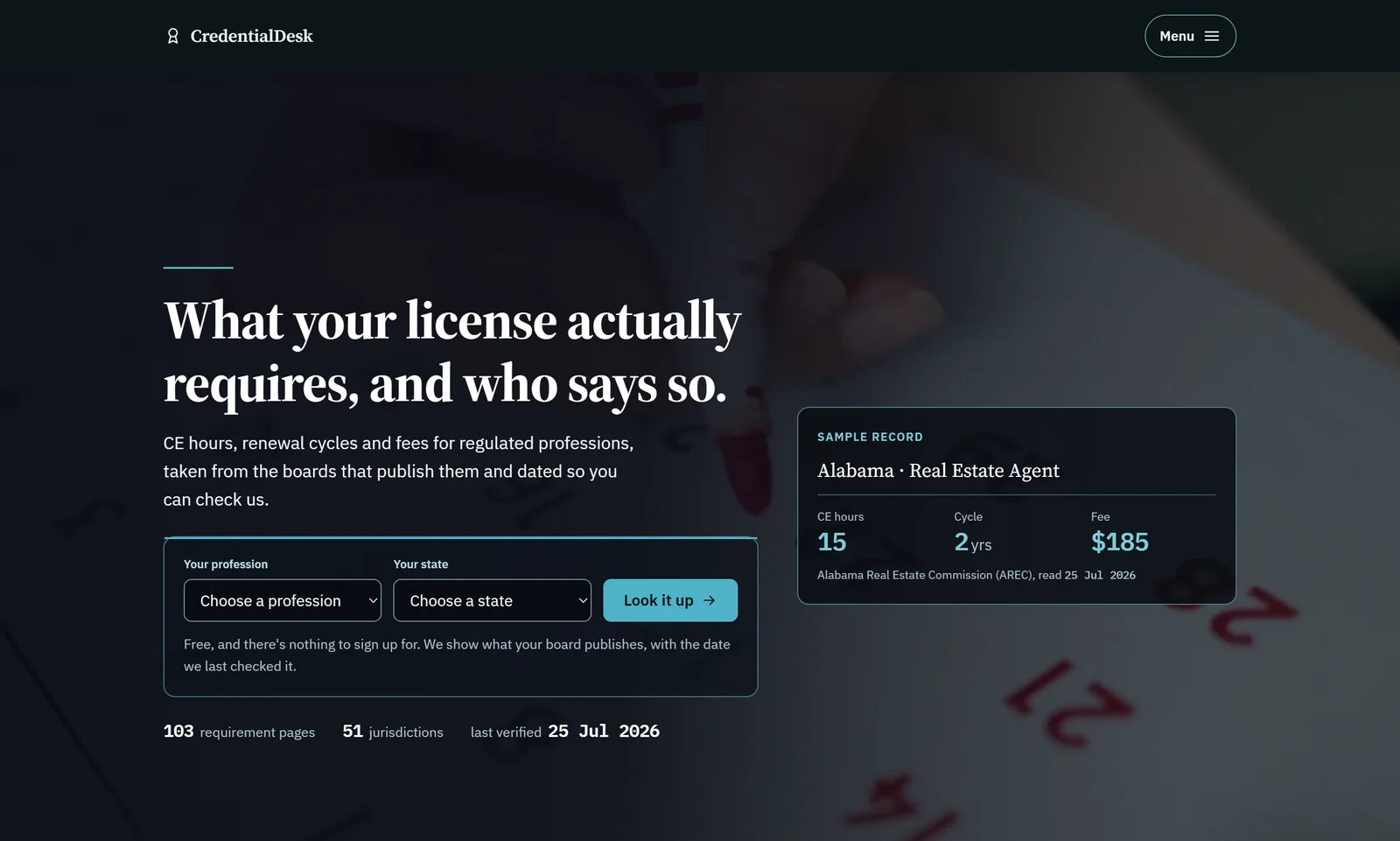
What a professional licence actually requires, and who says so. Continuing-education hours, renewal cycles, and fees for regulated professions, taken from the board that sets each rule.
Most licence-renewal pages online are a summary of a summary, with no source and no date. CredentialDesk publishes the board's own figure, names the board, links to the page it is printed on, and records the day it was read. If a board does not publish a number, the page says so rather than filling the gap.
Free to read, nothing to sign up for, and we sell no CE courses.
- Requirements
- 103
- Jurisdictions
- 51
- Professions
- 3
Cited to the board
Every figure links to the licensing board that publishes it, by name and by URL. Not a reseller, not an aggregator, and never shown as a badge.
Dated so you can check
Each page carries the day we last read the board's own page, because a requirement with no date behind it is a rumour.
Profession by state
Registered Nurse and Real Estate across all 51 jurisdictions, plus CPA in California. CE hours, renewal cycle, and fee for each.
No placeholders, no signup
Where a board does not publish a figure, the page says which board and why. Pages exist only where there is real content, and the whole site is free to read.
PSPCR
A workforce readiness platform for growing companies in regulated industries. Training records, credentials, and expiry dates in one place, so “is everyone current” takes a second to answer.
Still in development, no launch date announced. If you run compliance for a team, what your current tools get wrong is worth more to us right now than a spot on a waiting list.
Who's current, who isn't
Every requirement a role carries, tracked per person, with the gaps on the first screen.
Dated records
Each entry carries its date and its source, so an audit request is a query rather than a search through email.
Teams, sites, and roles
Organize by department, location, or crew. Role-based access means a site lead sees their own people, not the whole company.
Change history
Who recorded what, when, and against which requirement. Kept for the industries that get asked to prove it.
What expires next
Everything lapsing in the next 30, 60, and 90 days, ordered by what stops work when it does.
Priced below the enterprise tools
This category is mostly sold to enterprises and priced there. PSPCR is aimed at the companies underneath them.
Developer tools
Two things we needed badly enough to build and permissively licensed enough that you can read every line before you run them.
skim
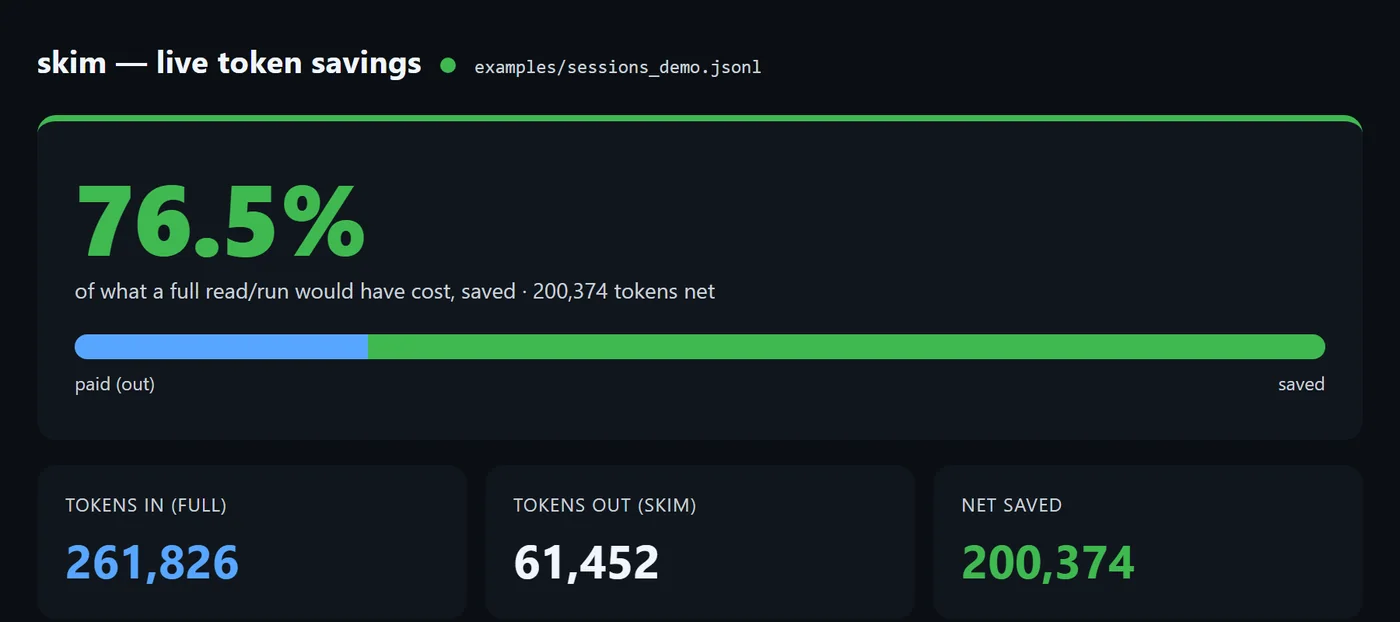
MITOn PyPIAn MCP server that gives coding agents a cheaper way to read. Rather than pulling a whole file into a model's context, skim returns a compact skeleton plus anchors, and the agent expands the exact spans it needs. Nothing is summarised or paraphrased, so the text that lands in context is the real source and everything else is one call away.
The whole package is under two thousand lines of standard-library Python with a single runtime dependency, which makes an afternoon's security review a realistic thing to ask for. Windows is a first-class platform, not an afterthought, and the shell and edit tools each have an environment switch that removes them for read-only installs.
Skim, then expand
A large file comes back as a skeleton of structure and signatures with anchor ids. The agent expands only the spans it needs, verbatim.
Files, repos, and output
Python and roughly seventeen more languages, whole-repo maps within a token budget, and verbose test or build output, all recoverable.
Checkable, not claimed
A skim-verify command checks five invariants against your own files, so the lossless claim is something you run rather than something you take.
XLS Converter
MITA conversion service that turns XLS, CSV, ODS, and JSON into clean XLSX. It exists because the legacy binary Excel formats were never publicly specified, which leaves JavaScript spreadsheet libraries reverse-engineering them and disagreeing with each other on the awkward files.
So the parsing happens in Python, where those formats have been handled reliably for years, behind a JavaScript interface and a small HTTP service. Formulas are stripped during conversion, API endpoints sit behind token auth, and the container image is kept deliberately small.
Legacy XLS, handled properly
The old binary Excel formats have no public specification, so JavaScript libraries reverse-engineer them. This uses Python's mature parsers instead.
Formulas stripped on the way in
Converted output has its formulas removed, which closes off the spreadsheet-formula injection path into whatever opens the file next.
Small, hardened container
A minimal base image and a deliberately narrow dependency surface, so what you deploy is small enough to actually audit.
What we're looking at
Three areas we keep running into. Nothing's announced, and there are no dates on any of it.
Business tools
Reporting and workflow jobs that currently take three subscriptions and a spreadsheet only one person in the building understands.
Knowledge management
Somewhere for a team's documents and decisions to live, findable a year later by someone who wasn't in the room.
Learning and training
Course delivery, progress tracking, and content libraries, with attention on the middle of it rather than the demo.
If one of these is a problem you have right now, we would rather hear about it before we build than after.